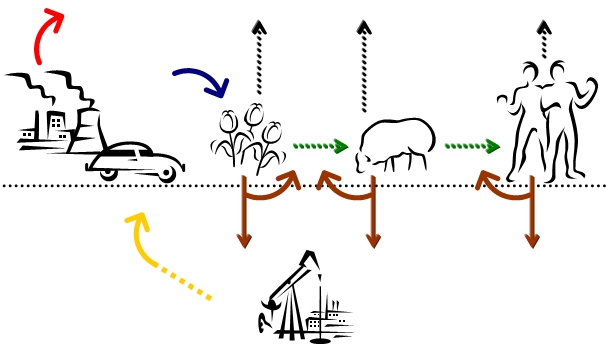
Plants take in carbon dioxide from the air and use sunlight to convert (through photosynthesis) the carbon dioxide and water (from the soil) into sugar and oxygen. Some of the sugar is used by the plant for its life processes (such as growing and reproducing); the excess is added to plant tissues as carbohydrates, fats, and protein.
Carbon is an element that readily combines with other elements to make organic compounds. All life on earth is carbon-based. A lot of your body is made of carbon and some of your body carbon parts were plant parts a few months ago. Carbon, used by all living organisms, continuously circulates in the earth's ecosystem. In the atmosphere, it exists as colourless, odourless carbon dioxide gas. Plants take in carbon dioxide during photosynthesis and give out carbon dioxide during respiration.
When herbivores eat the plants, they acquire the carbon stored in plant tissues. Much of the food (carbon compounds) eaten is used up for the herbivore's life processes and given off as carbon dioxide in respiration but some is stored in animal tissues.
If that herbivore is then eaten by a carnivore (or omnivore) the carbon (stored in the animal tissues) will be passed on again.
Dead plants and animals decay and carbon dioxide is released into the atmosphere to be used by plants again. The carbon cycle repeats itself endlessly. No matter is created or destroyed in this process. It only changes form and location.
Some carbon from dead plants is temporarily removed from the carbon cycle as fossil fuels such as coal, oil and natural gas. Fossil fuels give out carbon dioxide when burned. Industries, coal-fired power plants and exhausts from motor vehicles have contributed additional carbon dioxide to the environment.
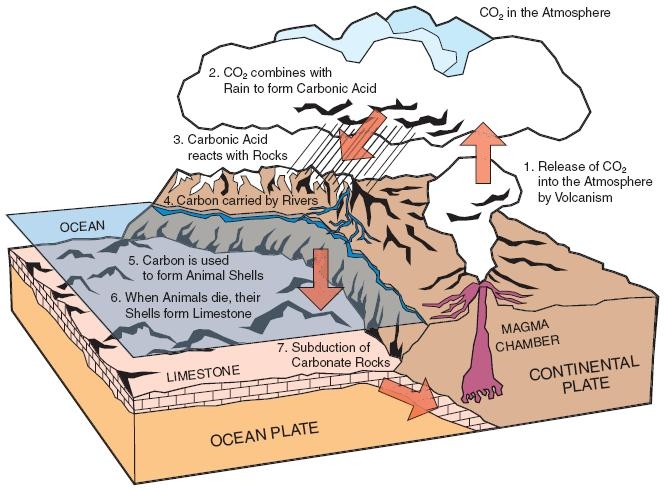
The above diagram shows the "BIOLOGICAL" carbon cycle - carbon cycling through vegetation, herbivores, carnivores/omnivores, soil and in fossil fuel burning. There is another part of the carbon cycle - the "GEOLOGICAL" carbon cycle (or carbon-rock cycle) as shown in the diagram below (modified from National Aeronautics and Space Administration).
The Geological Carbon Cycle
Mouseover the words on the picture to learn more
CONCERN OF RISING EMISSIONS: What would happen if the carbon dioxide in Earth’s atmosphere increased? The Earth's surface temperatures would increase. If temperatures increased too much, humans (and other forms of life) might not be able to survive.
Cars that pollute the environment less than standard gasoline-powered cars.At its recent meeting in Bangkok (May 2007) - with international economists, scientists and government officials from more than 100 countries - the United Nations' Intergovernmental Panel on Climate Change (IPCC) raised the concern of rising emissions. The rise in global income and the world's population have added to the burning of oil, coal and gas. As a result, emissions of greenhouse gases have shot up 70% between 1970 and 2004. For carbon dioxide alone, the increase was 80% in the same time period.Explore how hybrid cars work Chemical fuel cells How to Build a Solar Car
The options to tackling emissions are
- Pricing carbon: Consumers and producers should pay a price for goods and services which reflects the environmental damage from using fossil fuels. This promotes energy efficiency and the switch to cleaner sources.
- Renewable energies: Wind, solar and geothermal power should be promoted through subsidies, preferential tariffs and rules requiring buying from these sources.
- Energy efficiency: Tougher building standards, mandatory fuel economy, biofuel blending and investment in better public transport.
- Carbon sequestration: Building underground chambers to store CO2 emissions from coal-fired plants.
- Nuclear power: Wider use of nuclear energy, up from 16% of electricity supply in 2005 to 18% share by 2030.
Water Cycle | Rock Cycle | CARBON CYCLE | Nitrogen Cycle